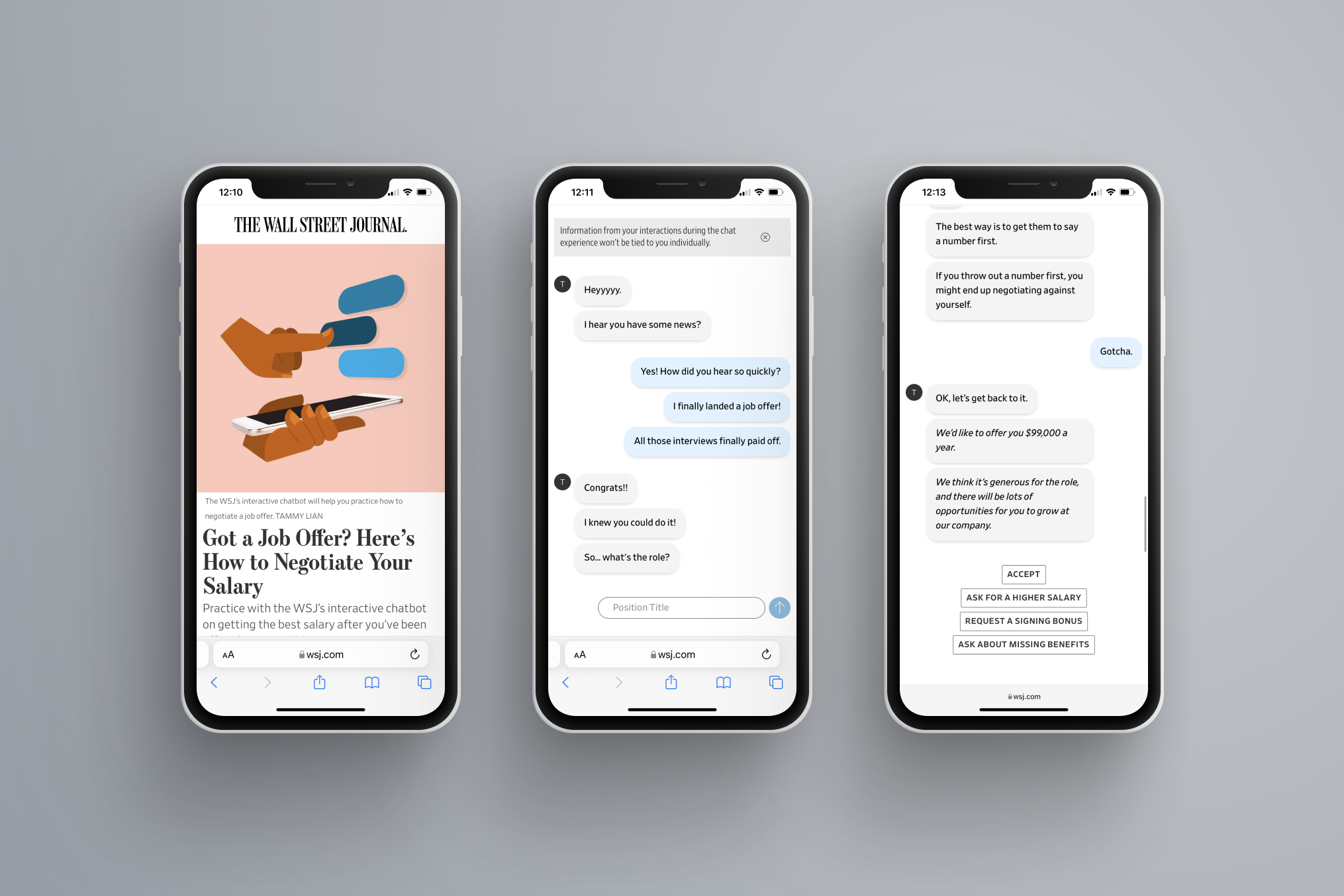
WSJ ‘Salary Negotiation’ Chatbot
An interactive narrative format (such as choose-your-own-adventure stories) to encourage readers to explore a topic, or to learn through being in simulated situations.
We hypothesize that these experiences are particularly useful for extending a ‘searchers’ journey. For example, a person who found the answer to “how to dress for an interview” in our guides might be more easily led to other related guide content (and learn more about how to ace their upcoming job interview) through an interactive ‘mock job interview’ type experience. This could also be useful to deepen engagement, and encourage clickthroughs, in email courses.
Background
WSJ ‘How To’ Guides
Relaunched evergreen guides that provide step by step advice on a topics such as personal finance, navigating the workplace, building a career path and network, etc.
How can we extend the ‘search’ journey?
How do we turn ‘fly-by’ searchers into habitual returners?
How do we display related content on the broader topic?
Can we establish any reusable processes, tooling, or code to make interactive formats easier to create in the future?
Process
Moodboard + Competitive Analysis
Group share of alternative concepts and a brief competitive analysis to understand what already exists and the audience response
Diverge
Individually explore, develop and iterate creative ways of solving the problem, regardless of feasibility.
Converge
Present, discuss and combine ideas (Return to individual exploration) identify possible constraints/barriers and explore them in further detail.
Decision Tree
Flesh out the user flow and define their journey, set up a decision tree as the base of the chatbot script.
Design Actions
From the decision tree, 6 user interactions were identified including:
Open Response
Sole response
Dual response
Multichoice response
Multiselect response
CTA